Diploma vs B.Tech in Electrical Engineering: Which Is Right for You?
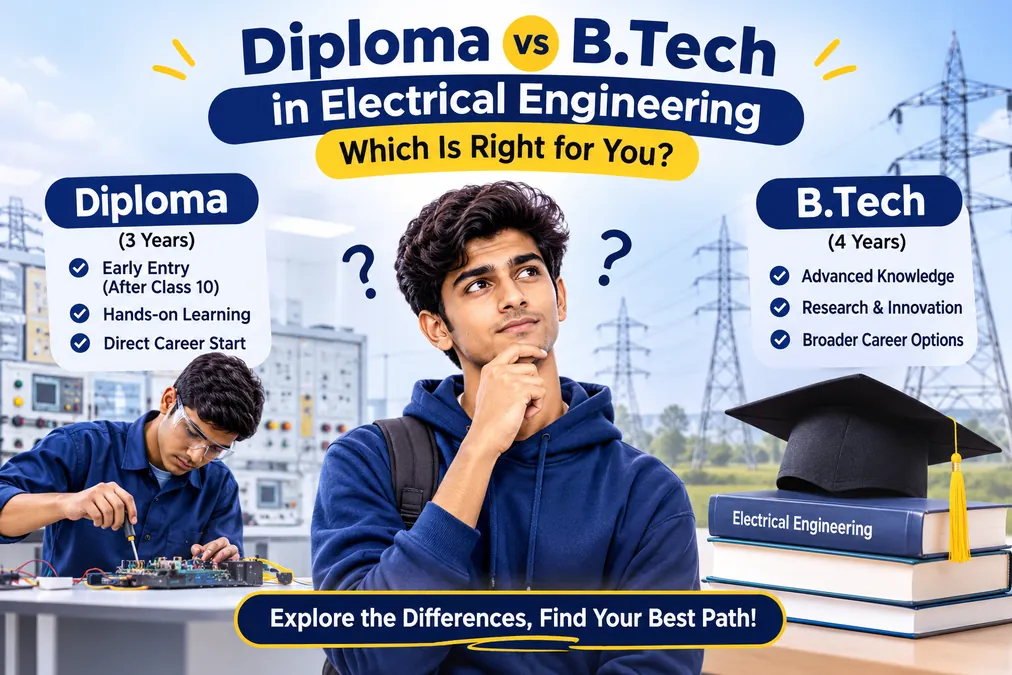
Electricity powers everything, from factories to the phone in your hand, and the people who keep it running are always in demand. But after school, a big question appears: should you start early with a diploma or head straight into B.Tech electrical engineering? Both paths lead to rewarding careers, yet they suit different learners, timelines, and goals.
This guide breaks down the differences, covering duration, learning style, careers, and costs. By the end, you will know which path fits you best. Let’s get started.
What Is a Diploma in Engineering?
A diploma in engineering is typically a three-year programme you can begin right after Class 10, usually at a polytechnic institute. The focus is practical, with hands-on laboratory training and an industry-oriented curriculum. Here is why students like it:
- Early entry: You begin technical education sooner than classmates heading for degrees.
- Practical skills: Lab work builds confidence with real equipment from the start.
- Flexible next steps: You can start working as a technician or continue through lateral entry into B.Tech.
It suits learners who want technical experience quickly and an earlier start in the workforce.
What Makes a B.Tech Degree Different?
B.Tech is a four-year undergraduate degree, usually pursued after Class 12 with science. It leans towards advanced engineering theory, research, innovation, and specialised fields, with subjects such as mathematics, physics, programming, and engineering design.
B.Tech electrical engineering builds on that base with power systems, machines, and automation. Graduates often move into engineering development, research, product design and management, with deeper academic knowledge and broader career options than a diploma usually offers.
| Factor | Diploma in Engineering | B.Tech |
| Duration | 3 years | 4 years |
| Entry point | After Class 10 | After Class 12 with science |
| Learning focus | Practical, hands-on labs | Advanced theory, research, innovation |
| Typical starting roles | Technical support, supervisory | Design, project management, research |
| Next step | Lateral entry into B.Tech | Specialised roles and leadership |
Which Path Is Better for You?
It depends on your background and goals. If you enjoy early practical exposure, a diploma may suit you. If advanced technical knowledge or research excites you, B.Tech is the stronger fit. Many students also combine both:
- Start with a diploma after Class 10.
- Enter B.Tech through lateral entry.
- Gain both practical and theoretical knowledge.
Whichever route you choose, compare electrical engineering courses in Dehradun on labs, projects, and internships, not just on course names.
What Does B.Tech Electrical Engineering at ITM Dehradun Offer?
The four-year B.Tech in Electrical Engineering at ITM Dehradun is designed for careers in electrical systems, power engineering, and emerging technologies. ITM B.Tech programs are AICTE-approved and Uttarakhand Technical University-affiliated, with 550+ hours of structured training, a 6/9-month internship, and access to 1,200+ recruiters. If you want a B.Tech electrical engineering program with a real-world focus, here is the snapshot.
| Feature | Details |
| Duration | 4 years |
| Core curriculum | Power systems, renewable energy, electrical machines, automation, industrial electronics |
| Also covers | Circuits, control systems, electronics and industrial instrumentation |
| Learning approach | Labs, live projects, internships and technical training |
| Tuition fee | ₹3,80,000 |
| Registration fee | ₹10,000 |
| Total | ₹3,90,000 |
| Scholarships | Up to 100% on tuition through N-SAT, based on percentile score |
| Eligibility | Class 12 with Physics, Chemistry and Maths; 45% aggregate (40% for reserved categories); appearing candidates can apply |
| Documents | 10th and 12th marksheets, government photo ID, passport-size photographs |
What Career Opportunities Follow Each Path?
Both diploma holders and B.Tech graduates can build strong careers. Common sectors include:
- Manufacturing industries: Plants rely on electrical professionals to keep systems and equipment running.
- Construction and infrastructure: Projects need people who understand electrical systems and their real-world applications.
- Electronics and automation: Industrial electronics and automation skills open doors here.
- Software and IT services: Technical graduates also find openings in technology-driven companies.
Diploma graduates often begin in technical support or supervisory roles, while B.Tech graduates may work in engineering design, project management, or research. With experience, both paths can lead to leadership positions. Students scanning job-oriented courses in Dehradun should check how practical training and placement preparation are built in. ITM’s B.Tech structures its learning so that placement preparation arrives in the final year.
So, Which Path Should You Choose?
Choose a diploma if you want early hands-on experience, quicker entry into work, and the option of lateral entry later. Choose B.Tech electrical engineering if you are drawn to deeper theory, research, and broader long-term roles, and you are ready for a four-year journey. Neither path is a dead end, and combining them is perfectly valid. Whatever you pick, look for practical labs, internships, and placement support. If the degree route appeals, explore ITM Dehradun’s program, check the eligibility criteria, and apply.
Your electrical engineering career starts with one well-informed decision.
FAQ’s
Applicants need Class 12 with Physics, Chemistry, and Mathematics and at least 45% aggregate, or 40% for reserved categories. Students appearing in Class 12 board exams can also apply. Required documents include marksheets, a government photo ID, and passport-size photographs.
The four-year B.Tech Electrical Engineering at ITM Dehradun costs ₹3,80,000 in tuition fees plus ₹10,000 registration, totalling ₹3,90,000 overall. Scholarships up to 100% on tuition are available through the New-Age Scholarship and Admission Test (N-SAT), based on your percentile score.
The curriculum covers power systems, renewable energy, electrical machines, automation and industrial electronics, along with circuits, control systems, and instrumentation. Labs, live projects, internships, and technical training help you apply concepts to real-world industrial problems and build practical engineering skills.
Choose a diploma if you want early hands-on experience after Class 10 and quicker entry to work. Choose ITM’s four-year B.Tech if you prefer deeper theory, research, and broader roles. You can also combine both through lateral entry into B.Tech.
ITM Dehradun’s B.Tech programmes include 550+ hours of structured training, a 6/9-month internship and access to 1,200+ recruiters. Dedicated placement preparation arrives in the final academic year, supporting careers across manufacturing, construction and infrastructure, electronics and automation, and IT services.